

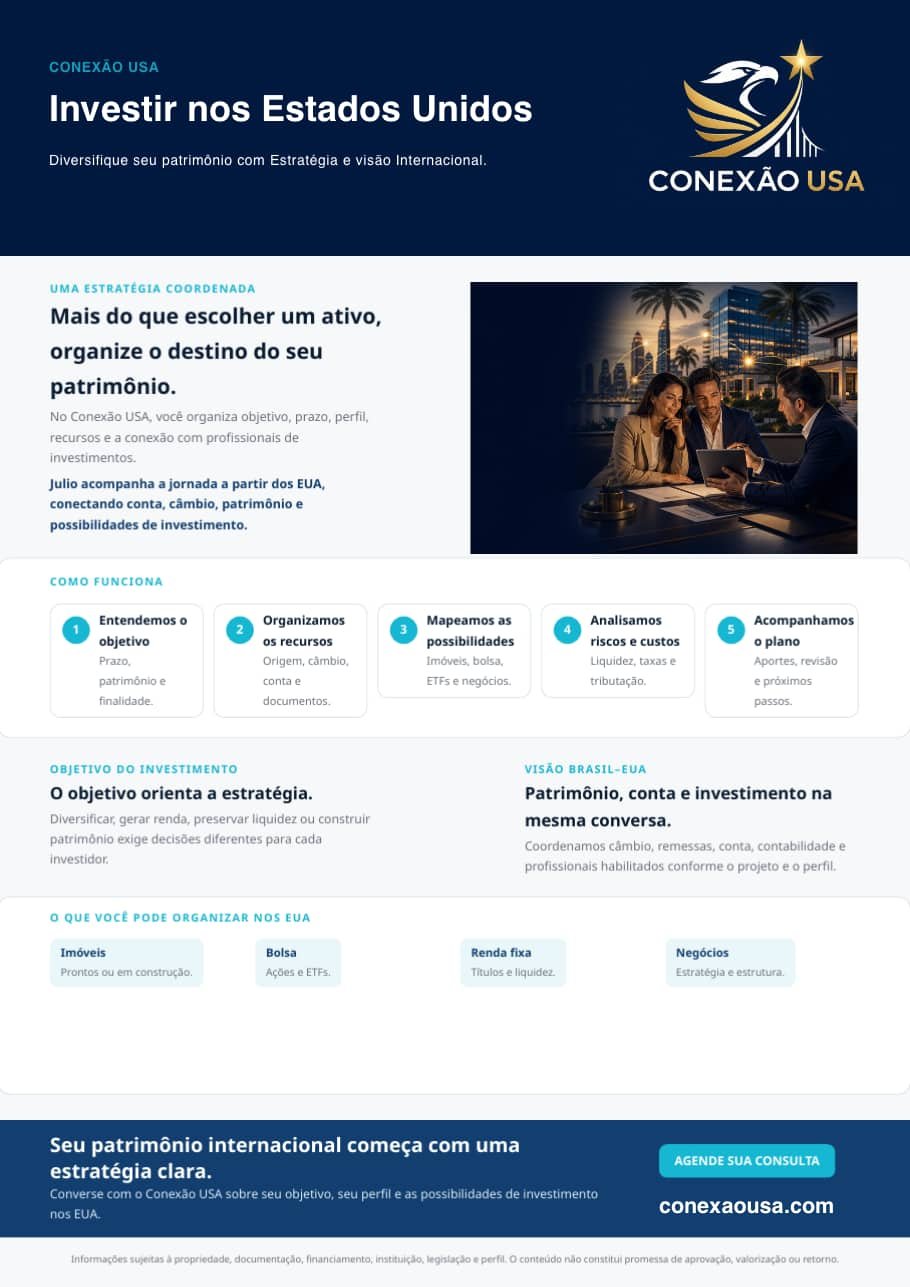

Invest in the United States with strategy and an international perspective
Investing in the United States may mean buying a completed property, participating in a real estate development project, accessing the American stock market, investing in ETFs, evaluating fixed-income securities, learning about REITs, or structuring an interest in a business.
Each alternative has its own characteristics regarding risk, liquidity, time horizon, documentation, taxation, and potential return. Therefore, an international investment strategy begins before choosing an asset: it begins by understanding your objective, wealth, investment capacity, and the role the United States will play in your overall planning.
At Conexão USA, we help organize this dollar-based journey by coordinating currency exchange, accounts, accounting, wealth structure, and connections with specialized institutions and professionals.
More than investing in dollars, build an international strategy
Diversification does not simply mean sending money to the United States or choosing a familiar asset. The SEC explains that asset allocation involves dividing investments among categories such as stocks, bonds, and cash while considering investment horizon and risk tolerance.
Diversification seeks to distribute resources among different investments to manage risk, but it does not eliminate the possibility of loss. [1]
The central question is: what function should this investment serve in your wealth?
Diversify part of your wealth
Build income
Purchase a property
Participate in a development project
Invest in the American stock market
Prepare to move to the U.S.
Structure a business
How the process works with Conexão USA
1. We understand your objective
We discuss the reason for investing, time horizon, liquidity needs, current exposure to Brazil, relationship with the United States, and the role the investment should play in your planning.
2. We organize your financial structure
We assess the need for an account, transfer, currency exchange, documentation, source of funds, and possible Brazil–U.S. accounting support. Organizing this foundation facilitates execution but does not eliminate market, currency, or operational risks.
3. We map the possibilities
We present the main categories that may be relevant to the project: completed properties, properties under construction, stocks, ETFs, bonds, REITs, businesses, and other alternatives available through qualified institutions or professionals.
4. We connect you with specialists
We coordinate communication with financial institutions, brokers, managers, accountants, attorneys, developers, and other specialists required according to the nature of the opportunity.
5. We analyze information, costs, and risks
Before moving forward, we organize questions about documentation, fees, liquidity, time horizon, negative scenarios, conflicts of interest, offering structure, taxation, and exit strategy. The objective is to reduce decisions based only on promises or enthusiasm.
6. We follow the next steps
After the investment, the journey may involve account monitoring, reports, tax filings, income distributions, property management, rebalancing, additional contributions, or exit planning.
Investment possibilities in the United States
Completed Properties
A completed property may be purchased for housing, a second home, rental, business use, or wealth building. Planning should consider location, price, financing, inspection, insurance, taxes, maintenance, management, occupancy, and liquidity.
The property may generate income or appreciate, but neither result is guaranteed. Performance depends on the market, property, operation, expenses, location, and timing of purchase and sale.
Points to analyze: purpose, location, purchase structure, source of funds, financing, closing costs, insurance, management, and taxation.
Suggested internal link: Buy Property in the USA
Properties Under Construction and Investor Projects
Real estate development projects may offer an alternative to purchasing a completed property. The investor may participate in a residential, commercial, or hospitality development, according to the offering structure and applicable law.
For this type of opportunity, analysis must go beyond the project’s images or appreciation expectations. It is important to understand who the developer is, the legal structure, how funds will be used, timelines, delay risks, exit conditions, guarantees, fees, and how any potential income will be distributed.
Construction may face changes in costs, licensing, financing, demand, schedule, and execution. Therefore, offering materials, contracts, and risks should be reviewed by qualified professionals before a decision.
Points to analyze: developer, track record, location, schedule, budget, contract, guarantees, governance, liquidity, fees, taxation, and delay or loss scenarios.
American Stocks
The American stock market provides access to companies in different sectors and sizes. Stocks represent ownership in companies and may experience significant price changes due to economic, political, business, and market factors.
Investing in stocks requires defining the objective, time horizon, tolerance for losses, liquidity needs, and acceptable level of concentration. Choosing a specific company should not be based only on popularity, news, or past performance.
Points to analyze: sector, business model, results, debt, price, volatility, concentration, brokerage costs, currency exchange, and taxation.
ETFs
ETFs pool resources from multiple investors and may invest in stocks, bonds, short-term instruments, or combinations of these assets. Many ETFs provide exposure to various companies or sectors, but a concentrated fund does not necessarily provide sufficient diversification. [2]
Before investing, it is important to analyze the fund’s objective, portfolio, costs, liquidity, tracking method, risks, prospectus, and fit within the overall wealth structure. Investor.gov highlights that ETFs are not guaranteed or insured by the FDIC and that an investor may lose part or all of the amount invested. [2]
Bonds and Fixed Income
U.S. Treasury securities, corporate bonds, fixed-income funds, and short-term instruments have different characteristics regarding maturity, issuer, rate, liquidity, credit risk, interest-rate risk, and taxation.
A fixed-income alternative should not automatically be treated as “risk-free.” Even investments considered more conservative may be affected by inflation, interest-rate changes, currency fluctuations, and loss of purchasing power.
REITs and Real Estate-Market Exposure
REITs may provide exposure to real estate or real-estate-related assets without requiring the investor to directly acquire a property. Risks, liquidity, distributions, interest-rate sensitivity, and composition vary according to the vehicle.
A REIT is not equivalent to buying a house. The investor needs to understand the portfolio, leverage, properties, contracts, management, distributions, volatility, and costs.
Businesses and Business Interests
Some Brazilians consider investing in American companies, acquiring an interest in a business, supporting an existing operation, or creating their own company. In this situation, analysis involves capital, governance, operations, contracts, accounting, taxation, immigration when applicable, and business risk.
An interest in a business may have low liquidity and may depend heavily on management, customers, suppliers, the market, and execution. Conexão USA can help organize the necessary connections with accountants, attorneys, specialists, and local professionals.
Private Offerings and Crowdfunding
Private offerings, real estate projects, and crowdfunding opportunities may have eligibility rules, limits, resale restrictions, and higher risks than exchange-traded assets. The SEC states that offerings under Regulation Crowdfunding must occur through a registered intermediary and require certain disclosures, but invested amounts remain subject to the risk of the operation. [3]
Before any contribution, it is necessary to understand the offering documents, who may invest, how resources will be used, what fees apply, how exit works, and what happens in scenarios of delay, default, or project failure.
Are You Ready to Take Your Investments to the Next Level?
About
Conexão USA is the immigration consulting service for moving to the United States that you’ve been looking for. Dollarize your wealth, invest in the U.S., and immigrate to the United States — all with comprehensive guidance from a single consulting service.
Contact
- 7508 Wing Span Way, Harmony, FL 34773
- +1 305 467 6317
Business Hours
- Monday 9:00 AM - 6:00 PM
- Tuesday 9:00 AM - 6:00 PM
- Wednesday 9:00 AM - 6:00 PM
- Thursday 9:00 AM - 6:00 PM
- Friday 9:00 AM - 6:00 PM
Copyright 2026 © Conexão USA Immigration Consulting and Services. All rights reserved.